

Fire Survival Cables Explained: What Makes Them Different?
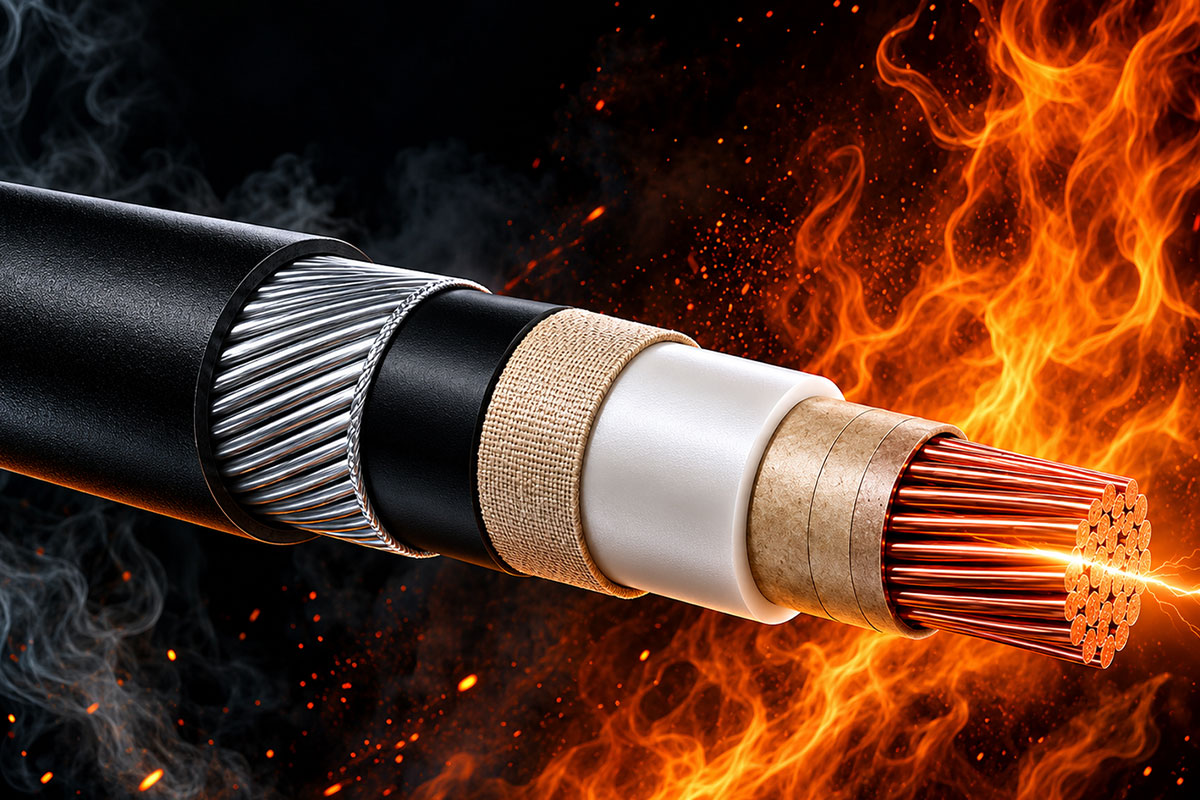
Not all cables exposed to fire behave the same.
The difference lies in engineering that remains hidden beneath the outer sheath.
In our previous blog, we discussed why Fire Survival Cables have become an indispensable part of modern buildings and critical infrastructure. Their primary role is not to prevent a fire, but to keep emergency systems operational long enough for occupants to evacuate safely and firefighters to respond effectively.
That naturally raises another question.
If two cables look almost identical from the outside, why does one fail within minutes while the other continues carrying power through a fire?
At first glance, the answer isn't obvious.
Both cables have a copper conductor. Both are insulated. Both are covered with an outer protective sheath. They may even have the same voltage rating and similar dimensions. Yet when exposed to the intense heat of a fire, their performance can be dramatically different. The difference isn't in one magical material or a single protective layer. It is in the way the entire cable has been engineered.
Fire Doesn't Destroy a Cable Instantly
Many people imagine that a cable simply burns and stops working. In reality, cable failure is a progressive process.
As temperatures begin to rise, the outer sheath is the first component to face the heat. Prolonged exposure gradually weakens the insulation surrounding the conductor. Mechanical strength reduces, polymers begin to degrade and the conductors may eventually come into contact with one another or lose continuity altogether. At that point, the electrical circuit fails.
This sequence may happen quickly in a conventional cable because it was never intended to operate under such extreme conditions.
A Fire Survival Cable, however, is designed with a completely different objective. Instead of merely resisting ignition, it is engineered to maintain circuit integrity for a specified duration, allowing critical electrical systems to remain operational during a fire. That single design philosophy changes everything.
Engineering Begins Long Before Manufacturing
One of the biggest misconceptions is that Fire Survival performance comes from adding a special tape or using a different insulation compound. In reality, fire survival starts much earlier, during the design stage. Engineers carefully select every component of the cable based on how it will behave when exposed to elevated temperatures. The conductor, insulation system, fire barrier, bedding, armour and outer sheath are not designed independently. They work together as an integrated system, where each layer has a specific role to play.
A Fire Survival Cable is therefore not just a conventional cable with additional protection. It is a cable whose entire construction is developed around one objective: keeping electricity flowing when normal cables can no longer do so.
A Fire Attacks the Cable Layer by Layer
One of the easiest ways to understand a Fire Survival Cable is to look at it from the fire's perspective. When flames engulf the cable, the outer sheath is the first layer to encounter the heat. Modern fire survival cables typically use Low Smoke Zero Halogen (LSZH) compounds for the sheath. These materials help reduce flame propagation, limit smoke generation and minimize the release of corrosive gases that could damage nearby equipment or obstruct evacuation.
However, no polymer can withstand direct fire indefinitely. As temperatures continue to rise, the cable begins relying on something much more critical, its fire barrier. This is where mica tape becomes one of the most important elements of the cable construction.
Unlike conventional insulation materials, mica remains remarkably stable at extremely high temperatures. Wrapped around the conductor with controlled overlap, it acts as a thermal barrier that helps maintain electrical insulation even after the outer polymer layers have started deteriorating.
Depending on the intended fire performance, the construction may use multiple layers of mica tape. Higher-performance constructions may further incorporate glass fibre reinforcement, providing additional mechanical and thermal stability during prolonged fire exposure. The objective is not to keep the cable looking intact. The objective is to keep the conductor electrically isolated long enough for emergency circuits to continue functioning.
The Insulation Still Plays a Vital Role
Once the fire barrier has done its job, the insulation system continues supporting the cable's performance. Fire Survival Cables commonly use cross-linked polyethylene (XLPE) insulation because of its superior thermal stability and mechanical strength compared with conventional thermoplastic materials.
Cross-linking creates a three-dimensional molecular network that allows the insulation to retain its shape and electrical properties even at significantly higher temperatures. This improves the cable's ability to withstand thermal stress during both normal operation and emergency conditions.
The insulation alone cannot guarantee fire survival. But together with the fire barrier, it becomes an important part of the cable's overall defense mechanism.
Strength Matters Too
Fire is rarely the only challenge a cable experience during an emergency. Falling debris, collapsing supports, vibration from firefighting operations or accidental mechanical impact can all occur while the cable is expected to remain operational. This is why many Fire Survival Cables intended for critical installations incorporate armouring, which provides additional mechanical protection and helps preserve the physical integrity of the cable during harsh conditions.
Similarly, bedding and sheath materials are selected not only for environmental protection during normal service, but also to ensure that the cable construction remains stable as temperatures rise.
Circuit Integrity Is the Real Measure of Performance
When discussing Fire Survival Cables, the conversation often revolves around temperature. In reality, temperature is only one part of the story. The real question is whether the cable can continue carrying electrical current while exposed to fire. This ability is known as circuit integrity, and it forms the basis of Fire Survival Cable design.
Imagine a fire alarm system that remains perfectly functional but loses power because the cable supplying it has failed. The equipment itself hasn't malfunctioned, yet the entire system becomes ineffective. For this reason, Fire Survival Cables are evaluated not merely on their resistance to flames, but on their ability to maintain electrical continuity under defined fire conditions. Ultimately, that is what determines whether emergency lighting stays illuminated, smoke extraction fans continue operating or fire pumps remain energized during a critical situation.
Why Testing Is More Important Than Claims
From the outside, two Fire Survival Cables may appear almost identical. Their labels may even carry similar descriptions. Yet their performance under actual fire conditions can differ significantly. That is why recognized product standards and independent testing play such an important role.
Standards such as IS 17505-1 in India and in India and BS 7846 internationally establish detailed performance requirements for Fire Survival Cables used in life-safety applications. Depending on the intended application, cables may also be evaluated for additional fire endurance, mechanical impact and water spray conditions to demonstrate their ability to maintain circuit integrity under increasingly demanding scenarios.
Independent third-party certification further provides confidence that the cable has not only been designed correctly but has also demonstrated its performance through rigorous testing. In fire safety, performance should always be proven, not assumed.
Engineering You Never See
Perhaps the most remarkable aspect of a Fire Survival Cable is that its engineering remains invisible throughout its service life. Once installed behind walls, inside risers or beneath cable trays, it attracts little attention. Years may pass without anyone giving it a second thought.
Yet hidden beneath its outer sheath are carefully selected materials, engineered construction and countless hours of design, testing and quality control, all intended for a situation everyone hopes will never occur. It's true purpose is revealed only during those critical moments when normal operating conditions no longer exist.
Conclusion
A Fire Survival Cable is far more than a collection of conductors, insulation and protective layers. It is the outcome of thoughtful engineering, where every component has a defined purpose and every design decision contributes towards maintaining circuit integrity under fire conditions. When viewed from the outside, it may look similar to many other cables. But beneath that outer sheath lies a carefully engineered system designed to continue carrying power when heat, smoke and time are working against it.
That is what makes a Fire Survival Cable fundamentally different.
The real engineering inside a Fire Survival Cable isn't designed to withstand everyday operation. It is engineered for that ‘one’ day when everything else is under extreme test.
Disclaimer: This blog has been authored based on technical understanding and industry knowledge of the author. The featured image is AI-generated and is intended solely as a conceptual illustration to complement the subject discussed.

 Back
Back