

When Fire Breaks Out, Will Your Cable Keep Working?
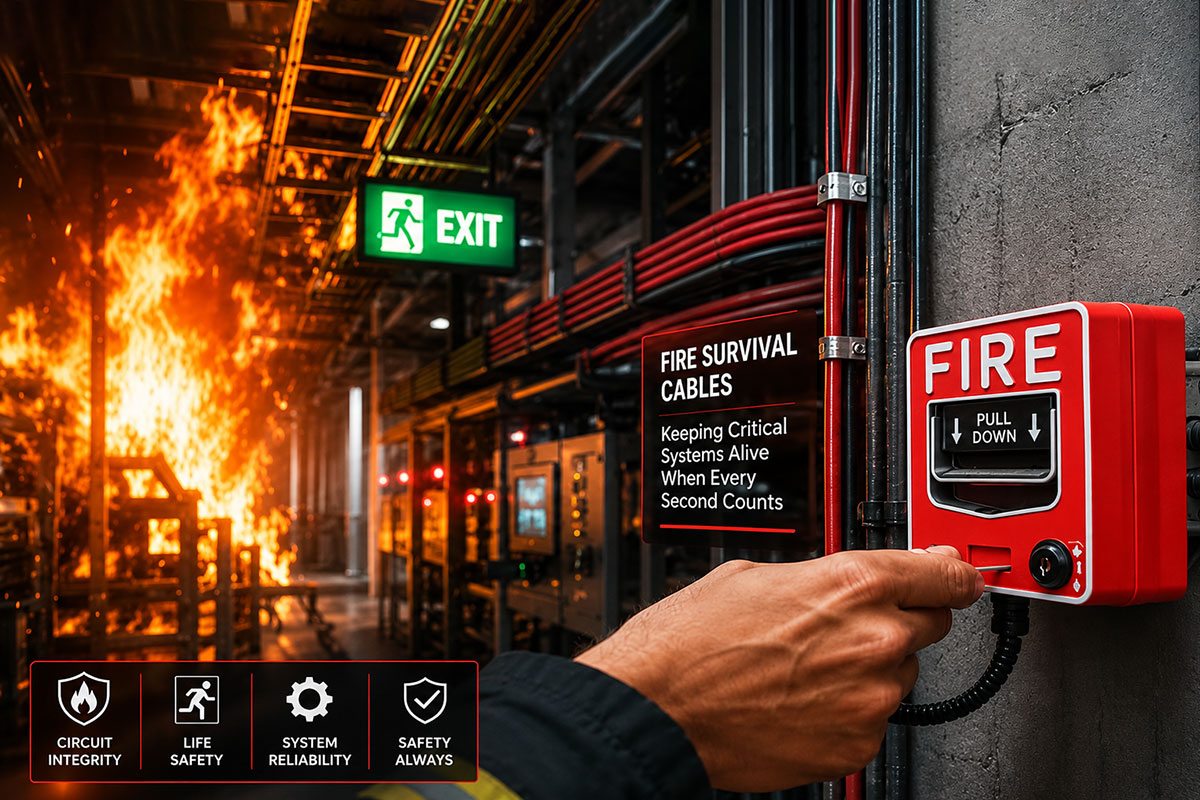
A fire survival cable isn't designed to stop a fire.
It's designed to keep life-saving systems running, when every second matters.
Over the last few years, India has witnessed several devastating fire incidents in hospitals, commercial buildings, factories, coaching centers and residential towers. While every incident has its own story, the investigation reports often point towards familiar causes, electrical short circuits, overloaded circuits, combustible materials, inadequate maintenance, or human negligence.
Yet, amidst discussions on how the fire started, one critical question often goes unnoticed.
What happened after the fire began?
Did the fire alarm continue to alert occupants? Were emergency lights still illuminating escape routes? Did the fire pumps continue supplying water? Were smoke extraction systems operational? Could the public address system guide people towards the nearest exit?
In many cases, the answer is unfortunately “No”.
Not because the equipment itself failed, but because the electrical circuits feeding these systems stopped working.
It is easy to overlook cables because they disappear behind walls, above false ceilings and inside shafts. Once a building is commissioned, they become almost invisible. But during a fire, these hidden cables suddenly become one of the most important components of the entire life-safety system.
Every Emergency System Depends on One Silent Component
Walk through any modern hospital, airport, metro station or commercial building and you'll find an impressive array of safety systems. Fire alarms continuously monitor the building, emergency lighting is positioned along evacuation routes, smoke extraction systems are designed to keep escape paths visible, and fire pumps stand ready to deliver water the moment sprinklers or hydrants are activated.
These systems appear independent, but they all rely on one common requirement, a continuous electrical supply.
A fire pump without electrical power cannot deliver water.
Emergency lighting without electricity cannot illuminate staircases.
Smoke extraction fans cannot remove smoke if their supply circuit has failed.
Even the most sophisticated fire alarm becomes ineffective if the cable connecting it to the power source fails during the first few minutes of a fire.
In other words, the equipment may still be perfectly functional. It is the electrical pathway that disappears. That pathway is the cable.
Fire Doesn't Kill Alone
When people imagine a fire, they often picture flames rapidly engulfing a building. In reality, the situation is far more complex.
Smoke usually spreads much faster than fire itself. Visibility drops within minutes, making it difficult for occupants to locate exits. Toxic gases begin accumulating in enclosed spaces, reducing the time available for safe evacuation. Panic adds another layer of complexity, particularly in crowded buildings where hundreds of people may attempt to escape simultaneously.
This is precisely the stage where emergency systems become most valuable. They guide people, control smoke, operate firefighting equipment and support emergency responders.
However, these systems can only perform their intended function if they continue receiving electrical power throughout the emergency.
Fire safety, therefore, is not merely about resisting flames. It is equally about maintaining the functionality of critical electrical systems while the fire is still in progress.
One Building. Two Different Outcomes.
Imagine two identical office buildings.
Both comply with fire safety requirements. Both have fire alarms, emergency lighting, smoke extraction systems and automatic sprinklers. On paper, they appear equally safe.
Now imagine that a fire starts in the electrical riser of both buildings.
In the first building, conventional cables lose their electrical integrity within a short duration as temperatures continue to rise. The insulation begins to deteriorate, circuits fail and one by one the emergency systems stop operating. The alarms fall silent, smoke extraction ceases and emergency lighting goes out.
The equipment hasn't failed. The electrical circuit has.
Now consider the second building.
The fire is equally severe, but the cables supplying emergency systems continue carrying electrical power despite being exposed to fire. The alarms continue operating. Smoke extraction remains functional. Fire pumps continue supplying water and emergency lighting keeps evacuation routes visible.
The difference between these two buildings isn't visible in architectural drawings. It is hidden inside the cable.
Flame Retardant (FR) and Fire Survival (FS) Are Not the Same
One of the biggest misconceptions in the electrical industry is that every cable advertised as "fire resistant" offers the same level of protection. They do not.
Some cables are designed to reduce flame propagation, preventing fire from spreading rapidly along cable routes. Others are engineered to emit lower smoke and lower toxic gases, improving visibility and reducing hazards during evacuation.
These are extremely important characteristics and contribute significantly to fire safety.
A Fire Survival Cable, however, serves a different purpose altogether.
Its primary responsibility is to maintain circuit integrity. Even while exposed to fire, it is designed to continue supplying electrical power to essential life-safety equipment for a specified period, allowing occupants to evacuate safely and firefighters to carry out rescue operations.
The distinction may appear subtle, but during an actual emergency, it can make all the difference.
Understanding Circuit Integrity
The term circuit integrity may sound highly technical, but the concept itself is straightforward.
Imagine a bridge during a flood. The bridge doesn't need to remain aesthetically perfect once the flood is over. Its most important responsibility is to remain functional long enough for people to cross safely.
Fire Survival Cables work much in the same way.
They are not expected to emerge from a fire looking new. Instead, they are expected to continue carrying electrical current while exposed to fire, ensuring that essential systems remain operational for the duration specified by applicable standards.
This ability to keep electrical circuits alive during a fire has become one of the most important principles in modern fire safety engineering.
The question is no longer: "Will the cable catch fire?"
The more relevant question today is: "Will the cable continue supplying power while the building is on fire?"
Why Standards Have Evolved
Modern buildings have become taller, smarter and significantly more dependent on electrical infrastructure than ever before. Hospitals rely on life-support systems, airports depend on integrated safety networks, metro stations require sophisticated smoke management systems and high-rise buildings operate complex evacuation and firefighting equipment.
As building technologies evolved, fire safety standards also had to evolve.
This led to the development of dedicated standards that evaluate a cable's ability to maintain circuit integrity under fire conditions. In India, IS 17505-1 establishes performance requirements for Fire Survival Cables used in emergency circuits. Internationally, BS 7846 has long been recognized as an important benchmark for enhanced fire performance. Independent third-party certifications such as LPCB further validate that products have successfully undergone rigorous testing under demanding fire conditions.
These standards are not simply compliance requirements. They are the outcome of decades of learning from real fire incidents across the world.
Where Fire Survival Cables Matter the Most
Fire Survival Cables are typically installed wherever uninterrupted operation of electrical systems directly influences life safety.
Some common applications include:
- Fire alarm systems
- Fire pumps and sprinkler systems
- Emergency lighting
- Smoke extraction and ventilation systems
- Public Address (PA) systems
- Fireman's lifts
- Exit signages
- Fire command centers
- Critical control and monitoring circuits
Although these systems perform different functions, they all share one common objective, to protect lives during an emergency. And they can only do that if the electrical circuit supplying them remains intact.
Fire Safety Is More Than Compliance
Too often, fire safety is viewed as a checklist. Install the alarms. Install the pumps. Install the emergency lighting. Obtain the approvals. But true fire preparedness goes beyond installation.
It requires asking a much more important question:
Will these systems still function when the building is actually on fire?
That answer depends not only on the equipment selected, but also on the cables connecting every critical system.
Fire Survival Cables may never receive the same attention as sophisticated fire detection systems or automated sprinklers. Yet they quietly perform one of the most vital roles in the entire safety chain, ensuring that electricity continues to reach life-saving equipment when normal cables are no longer able to do so.
Conclusion
Every major fire teaches the engineering community an important lesson. Building regulations improve, testing standards become more stringent and safety technologies continue to evolve. Yet one principle has remained constant.
People are not saved by equipment alone.
They are saved when the entire emergency system continues to function exactly as intended.
Hidden behind walls and ceilings, a Fire Survival Cable may never be noticed throughout the life of a building. But on the one day it is truly needed, it becomes one of the most critical links between electrical power and human safety.
The true value of a Fire Survival Cable is therefore not measured by the cable itself, it is measured by the time it gives people to evacuate safely, firefighters to respond effectively and emergency systems to continue doing what they were designed to do.
Because when every second counts, the most important cable in a building is the one that keeps working.
Disclaimer: This blog has been authored based on technical understanding and industry knowledge of the author. The featured image is AI-generated and is intended solely as a conceptual illustration to complement the subject discussed.

 Back
Back