

From Data to Light: How Does Optical Fiber Actually Carry Information?
Every time we send a WhatsApp message, join a video call, watch a movie or open a website, we rarely think about what is happening behind the screen. We simply expect the information to reach us.
Yet somewhere along that journey, the information we created as an electrical signal may be converted into something completely different: light travelling through a tiny strand of glass. That is the basic idea behind optical fiber communication. It may sound simple, but it is a remarkable combination of electronics, light, materials science and precision engineering.
So, let us follow the journey of a piece of information, from the moment it leaves a device to the moment it arrives at its destination.
How does digital data become a signal?
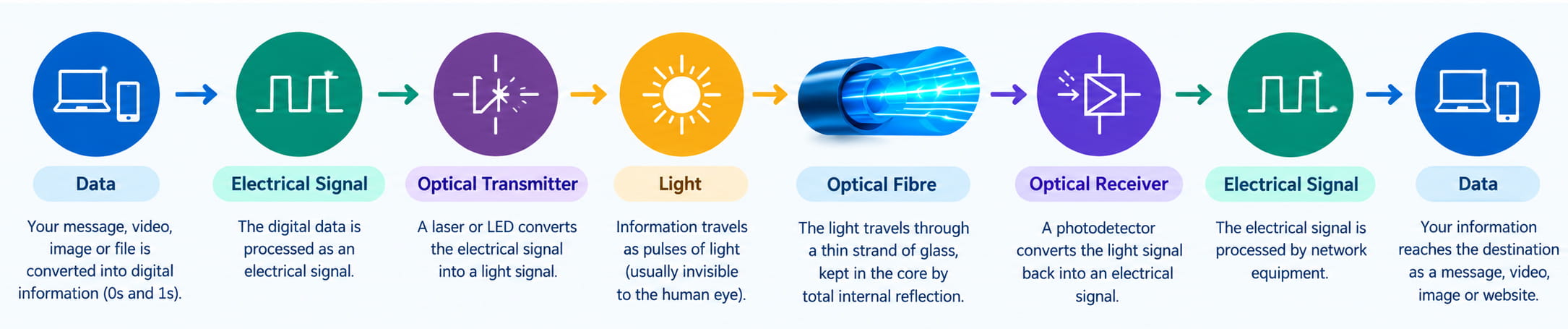
You type a message and press Send. The message is converted into digital information, which is ultimately represented by bits, the 0s and 1s understood by electronic systems. Your device and the network equipment around it process this information as electrical signals.
For shorter distances and many applications, electrical transmission works extremely well. However, modern networks have to carry enormous quantities of information, often over very long distances. This is where optical communication changes the game.
Instead of carrying the information only as an electrical signal, the network can convert it into an optical signal which means information represented using light.
This is where the world of photonics begins.
What does photonics have to do with communication?
Photonics is essentially the science and technology of generating, controlling and using light.
In an optical communication system, electronics and photonics work together. The electronics handles the data. A transmitter then converts that electrical information into an optical signal using a suitable light source, such as a laser or LED depending on the system. ITU (International Telecommunication Union) describes the basic optical communication process as “ a transmitter creates and encodes the optical signal; the fiber carries it, and a receiver converts it back into an electrical signal. ”
So, the fiber itself is not creating the information. It is carrying it.
How does light travel through such a thin fiber?
An optical fiber is made from highly transparent glass and has a carefully engineered structure. At the centre is the core, surrounded by the cladding. The core and cladding have different refractive indices, allowing the light to remain guided within the fiber.
A useful way to imagine it is to think of the core as the route through which the light travels, while the cladding helps keep that light confined to the intended path. This is associated with the principle of total internal reflection.
The result is a surprisingly powerful communication medium: a very small glass fiber can guide optical signals over long distances with relatively low signal loss.
What exactly is travelling through the fiber?
This is where the phrase “data travels as light” becomes more meaningful.
The information is encoded into an optical signal. The transmitter controls the light according to the communication system, creating changes in the optical signal that represent the information being sent.
The light then travels through the fiber.
At the other end, an optical receiver detects the incoming signal. A photodetector converts the optical signal back into an electrical form that electronic equipment can process.
That entire journey happens at remarkable speed.
Why is optical fiber used for high-speed communication?
This is not simply because light is “faster.”
The real advantage is the way optical fiber can carry enormous amounts of information with relatively low loss over long distances.
Optical fiber has become a foundation for telecommunications because it can transmit voice, video and data at very high rates. Its transmission characteristics also make it far less susceptible to electromagnetic interference than conventional electrical transmission.
There is another important point.
The fiber is physically tiny, yet its information-carrying capability can be enormous. That combination of small size, long-distance transmission and high capacity is one of the reasons fiber has become so important to today's digital infrastructure.
The internet may feel wireless when we use it on our phones, but much of the infrastructure supporting that experience is very much wired with optical fiber.
What happens to the light as it travels?
The journey is not completely loss-free.
As light travels through a fiber, some of its power is lost. This reduction in optical signal power is called attenuation, commonly expressed in dB/km for fiber. Attenuation can arise from phenomena such as absorption and scattering within the fiber, while bends and other practical conditions can introduce additional losses.
There is also another challenge: the optical pulse can spread as it travels. This phenomenon is called dispersion. If the spreading becomes significant, it can affect the ability of the receiver to distinguish information correctly.
So, designing a good optical communication link is not simply about getting light from Point A to Point B.
The objective is to get the right amount of light, with the right quality, to the receiver.
Why do engineers talk about wavelength, modes and fiber types?
Once we look a little deeper, optical fiber stop being “just a cable.”
Engineers have to consider the wavelength at which the system operates, how light propagates through the fiber, how much loss occurs, how much the signal spreads and how the fiber behaves under different installation conditions.
This is why terms such as 850 nm, 1310 nm and 1550 nm, single-mode, multimode, attenuation, dispersion, cut-off wavelength and mode-field diameter appear so frequently in fiber communication. They are not complicated terms created simply for engineers to remember. Each describes something that affects how efficiently information can travel through the fiber.
For example, single-mode and multimode fibers allow light to propagate in different ways and are suited to different network requirements.
And wavelengths matter because the transmission characteristics of fiber change with wavelength. Modern ITU-T (International Telecommunication Union - Telecommunication Standardization Sector) guidance covers characteristics such as attenuation, chromatic dispersion and cut-off wavelength across the operating range of single-mode fibers.
What really makes optical fiber special?
Perhaps the most interesting thing about optical fiber is how little we notice it.
We see a message appear on a screen. We hear someone's voice on a video call. We watch a high-resolution video without thinking about the network carrying it.
Behind that simple experience, information has been converted, encoded into light, guided through glass, detected at the other end and converted back into a form our devices can understand.
Data has travelled as light.
And that tiny strand of glass has quietly become one of the most important building blocks of the digital world.
The next time we look at an optical fiber, it is worth remembering that we are not simply looking at a glass strand. We are looking at a pathway for information - one that connects homes, businesses, data centres, cities and increasingly, entire digital ecosystems.
And there is much more happening inside that tiny strand than meets the eye: the way light enters the fibre, how it stays within the core, how it travels and what happens when it encounters distance, bends or other losses.
That takes us to the next part of the journey – inside the optical fibre itself, where the core, cladding and the science of guiding light come together.
The Journey has only just begun.
Disclaimer: This blog has been authored based on technical understanding and industry knowledge of the author. The featured image is intended solely as a conceptual illustration to complement the subject discussed.

 Back
Back