

Cable Standards Made Simple
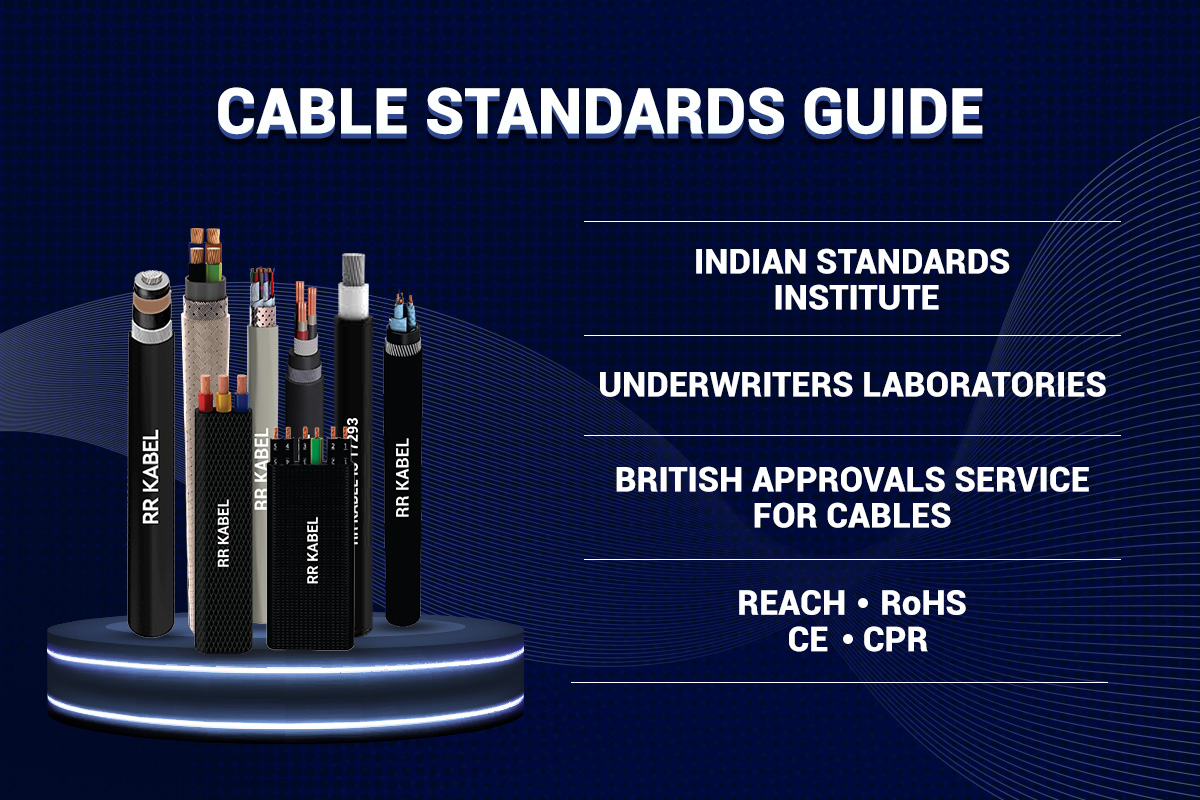
Electrical cables are among the most safety-critical components in any installation. Yet during procurement, decisions are often based only on price, appearance, conductor size or brand familiarity. What many users don’t realize is that cable safety and performance depend heavily on its compliance with recognised standards and certifications.
Whether it is a home, factory or infrastructure project, understanding cable standards helps avoid risks that often remain hidden until failure occurs.
What are cable standards and why do they matter?
Cable standards define how a cable must be designed, manufactured and tested before it is used in an installation. They ensure:
- correct conductor size and resistance
- adequate insulation thickness
- defined temperature performance
- safe behaviour under electrical stress
- consistent quality across manufacturers
Without standards, two cables with the same size marking could behave very differently in actual use. In simple terms, standards bring predictability to safety and performance.
What is BIS and how is it different from other global standards?
In India, cable standards are governed by the Bureau of Indian Standards (BIS).
- BIS defines the technical requirements (IS standards)
- BIS certification (ISI mark) confirms that a product complies with those standards.
Globally, other standards are also widely used:
- IEC (International Electrotechnical Commission) — international reference standards
- BS (British Standards) — widely used in UK and many export markets.
- UL (Underwriters Laboratories) — certification focused on safety, especially in North America
Each standard framework serves a different geography or application, but all aim to ensure safe and reliable product performance.
Are BIS, IEC, BS and UL all competing standards?
Not exactly, rather they are different systems serving different markets, not competitors.
A cable designed for India must comply with BIS requirements. A cable used in international or export projects may need IEC, BS or UL compliance depending on project specifications.
In many modern installations, especially industrial and infrastructure projects, cables are designed to meet multiple standards simultaneously.
What are product standards in Cables?
Product standards define how a cable is designed, constructed and tested to ensure it performs safely under electrical and environmental conditions. They typically cover:
- Conductor size, material and resistance
- Insulation and sheath thickness
- Voltage rating and temperature limits
- Mechanical strength and durability
- Electrical tests such as high-voltage withstand, insulation resistance and ageing
Common examples include BIS (IS standards in India), IEC (international), BS (UK) and UL (North America). In simple terms, product standards ensure that a cable is fit for purpose, whether it is used in a house, factory or infrastructure project.
They define how the cable should perform throughout its life, not just when it is new.
What is Regulatory and Environmental Compliance?
Regulatory and environmental compliances focus on what materials are used inside the cable, and whether they are safe for people and the environment. These do not define electrical performance directly but ensure that the product does not contain harmful or restricted substances.
Some widely known compliances include:
- REACH - restricts hazardous chemicals and ensures safe chemical usage.
- RoHS - limits toxic materials like lead, mercury and cadmium.
- CPR (Construction Products Regulation) - classifies fire performance such as flame spread and smoke emission (mainly in Europe)
- CE marking - indicates conformity with European safety and regulatory requirements.
These compliances become especially important in public buildings, exports and environmentally sensitive projects. In short, while product standards ensure the cable works safely, environmental compliance ensures it is safe to use and install.
What are System Certifications and why do they matter?
System certifications are related to the manufacturer’s processes, not directly to the cable design. They confirm that the company follows structured and audited systems for quality consistency, environmental responsibility and worker health and safety.
Common certifications include:
- ISO 9001 — Quality Management System
- ISO 14001 — Environmental Management
- ISO 45001 — Occupational Health & Safety
While these certifications do not guarantee product performance on their own, they indicate that the manufacturer has controlled processes, traceability and consistency. For buyers, this reduces the risk of variation between batches and ensures long-term reliability.
Why is this distinction important for buyers?
Because many products in the market may highlight one certification while lacking others. For example:
- A cable may meet environmental norms but not electrical standards.
- A product may be manufactured in an ISO-certified facility but not tested against BIS or IEC requirements.
- A cable may carry markings but not be fully compliant.
Understanding the difference helps buyers ask the right questions and avoid misleading claims.
How do standards impact real-life safety?
Most electrical failures do not happen instantly, they build up over time. Substandard cables may overheat under normal load, degrade faster in harsh environments, fail during voltage surges or contribute to fire hazards. Standards define how cables behave not just in normal operation, but also under abnormal conditions.
That predictability is what protects both equipment and people.
What should a buyer actually check before selecting a cable?
In practice, cable selection should go beyond size and price. A few key checks can significantly reduce long-term risks:
Relevant standard compliance
Ensure the cable meets applicable standards (BIS for India, IEC/BS/UL for specific projects or exports).Certification marking
Look for genuine markings such as ISI or equivalent, not just printed claims.Declared ratings
Check voltage rating, temperature rating and application suitability (power, control, fire-safe)Construction quality indicators
This includes insulation thickness, flexibility, shielding (if applicable) and overall finish.Application fit
A cable suitable for residential wiring may not perform well in industrial or high-temperature environments.Manufacturer credibility
Consistent quality, testing infrastructure and technical support matter, especially for large or critical projects.
A small difference at the selection stage can significantly impact safety, performance and lifecycle cost over the years.
Conclusion
Cable standards are not paperwork requirements they are engineering safeguards that define how safely and reliably a cable performs throughout its service life. Choosing standards-compliant cables ensures predictable electrical behaviour, better protection performance and long-term installation stability across residential, commercial and industrial environments.
In modern electrical systems, cable standards are not optional references; they are the foundation on which safety, reliability and performance are built.

 Back
Back