

Earthing in Practice: How to Ground Power, Instrumentation & Communication Cables Correctly?
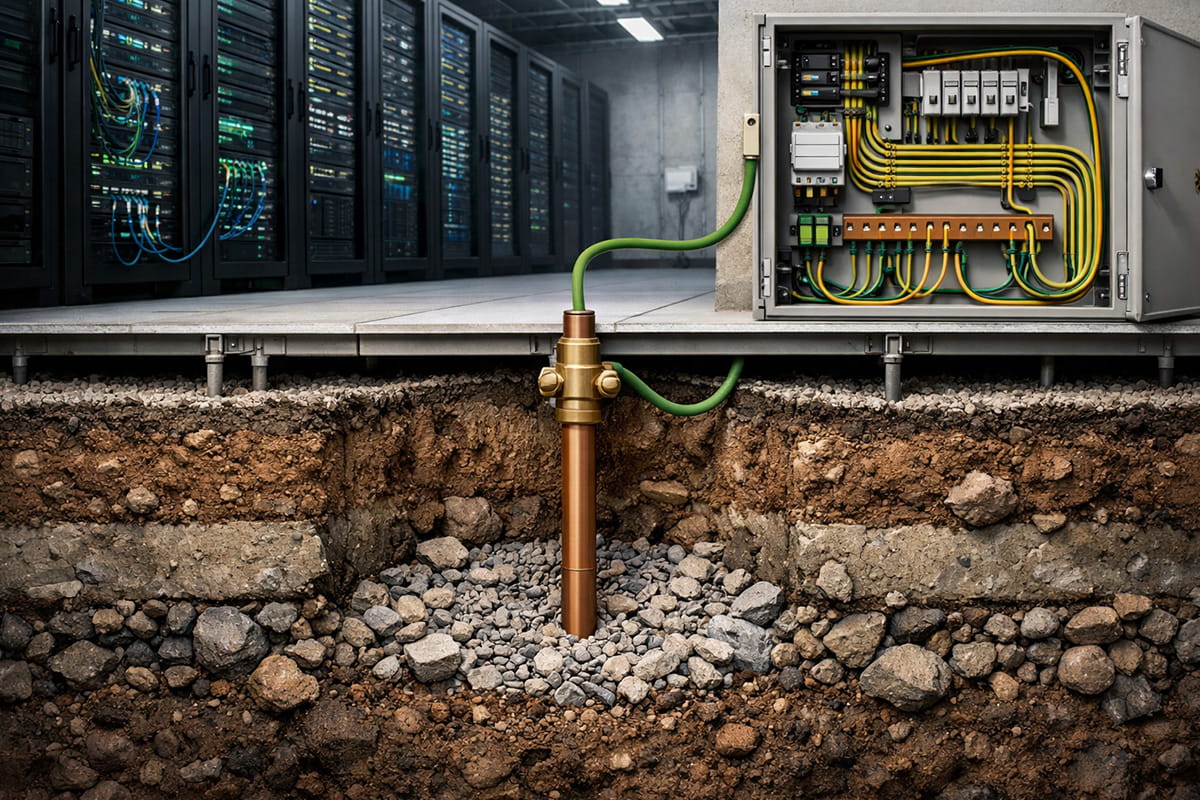
Understanding earthing (also known as grounding in many international standards) simply means connecting conductive parts to ground to provide a safe path for fault current. In real installations, however, multiple systems share power circuits, control wiring, data networks and automation equipment. Each behaves differently when grounded. Oversimplified approaches often lead to electromagnetic interference, ground loops, overheating and unreliable operation. Most field issues arise not from lack of knowledge, but from treating all cables and systems as if they respond the same way to grounding.
The “One Earth for everything” Problem
On many projects, especially where timelines are tight, everything gets connected to a common earth bar without deeper thought. Power panels, machine frames, PLC cabinets, cable trays are all bonded together and terminated at the nearest available point.
At first glance, it seems efficient.
But when drives start operating or when switching loads create electrical noise, that common path becomes a highway for unwanted currents. Sensitive instrumentation begins to fluctuate. Communication networks show intermittent errors. Operators start blaming equipment.
In reality, the issue often lies in uncontrolled current paths.
In well-designed systems, power earthing, instrumentation earthing and communication earthing are conceptually separated. They are bonded at an equipotential point and not mixed randomly throughout the installation. That distinction is small in drawing, but critical in performance.
How should armoured power cables be earthed?
Cable armour is not only mechanical protection; it also forms part of the fault current return path.
For low-voltage systems, armour is typically bonded at both ends so that any insulation failure allows sufficient fault current to flow back to the source, ensuring protective devices operate correctly. Problems arise when termination is inconsistent i.e., tightly bonded at one end and loosely connected or floating at the other. This can produce induced voltages or circulating currents.
In medium- and high-voltage systems, earthing becomes a design decision. Techniques such as single-point bonding or cross-bonding are used to control induced sheath voltages. At these levels, grounding is no longer routine installation work but part of system engineering.
How should shielded or screened cables be grounded?
Shielded cables are designed to block electromagnetic interference, but incorrect grounding can turn the shield into a noise collector.
For low-frequency analogue signals such as instrumentation loops, grounding the shield at both ends often creates a ground loop. This loop behaves like an antenna, picking up interference and causing unstable readings. In such cases, grounding at one end, typically at the control panel or receiving end, prevents circulating currents while preserving shielding effectiveness.
For high-frequency or digital signals, the situation can reverse. Bonding the shield at both ends may reduce impedance to high-frequency noise and improve performance. The correct approach depends on signal characteristics and system design.
What is the purpose of the drain wire in shielded cables?
Many instrumentation cables (shielded or screened) a drain wire which is a bare conductor in contact with the shield. On site, it is sometimes cut short or ignored. But the drain wire exists for a reason. It provides:
- A reliable low-resistance connection to earth
- Ease of termination without damaging the shield
- Consistent grounding performance
Best practice is to connect the drain wire to the designated earth terminal, not to random metallic parts of the panel.
Do LAN and communication cables need earthing?
Modern industrial networks rely heavily on Ethernet, and grounding must follow structured cabling standards.
Unshielded twisted pair (UTP) cables do not require grounding. Attempting to earth them externally can introduce imbalance and additional noise.
Shielded variants such as STP, FTP and SF/UTP are designed to be grounded through connectors, patch panels and equipment racks. Their grounding path is built into the system architecture. Arbitrary earthing at field points can disrupt signal integrity and increase interference rather than reduce it.
Why is equipotential bonding of cable infrastructure important?
Large installations are built in phases by multiple contractors, which can leave metallic structures electrically discontinuous. Cable trays, ladders, panels and machinery may appear connected mechanically but remain electrically isolated due to painted joints, flexible couplers or non-metallic supports.
Small voltage differences between these structures may not trigger protection systems but can cause nuisance shocks, communication errors or unintended current flow through cable shields.
Installing bonding jumpers across tray joints and ensuring proper earthing at defined intervals keeps the entire infrastructure at the same electrical potential, preventing hard-to-trace problems later.
Why do industrial installations need different earthing practices than buildings?
Commercial buildings typically contain relatively stable loads such as lighting, HVAC systems and office equipment. Electrical noise levels are moderate, and earthing mainly serves safety and lightning protection functions.
Industrial facilities operate in a far harsher electrical environment. Large motors, variable frequency drives, welding equipment and switching electronics continuously inject disturbances into the system. Parallel routing of power and signal cables or shared grounding paths can severely affect control system reliability.
Industrial installations therefore require planned cable segregation, dedicated grounding points for sensitive equipment and disciplined termination practices. What works in a building may be inadequate on a plant floor.
Does cable quality affect earthing performance?
Yes, even a well-designed earthing network can underperform if the cables themselves are not built to consistent electrical and mechanical standards.
In armoured power cables the armour itself often forms part of the fault current return path. If the armour construction is inconsistent, poorly galvanised, or mechanically weak, continuity across joints and terminations can degrade. This increases impedance in the earthing path and may delay the operation of protection devices during faults.
Similarly, in screened or shielded instrumentation cables, the effectiveness of the shield depends on its electrical continuity and coverage. Low-quality shielding tapes or braids can break or corrode over time, weakening the intended path for noise currents to drain to earth. This can lead to increased electromagnetic interference and unstable signal readings.
The insulation of the cable also plays an important role. Poor insulation stability near termination points can lead to moisture ingress, insulation deterioration, or leakage currents that interfere with grounding behaviour.
For these reasons, cable construction quality directly influences how effectively earthing works in real installations. This is why in critical installations, engineers increasingly evaluate not just the earthing system design but also the construction quality and electrical integrity of the cables that ultimately form part of that grounding path.
Conclusion
Effective earthing in real installations is less about connecting conductors to soil and more about controlling how currents flow through an interconnected system. Each cable type and application respond differently, and grounding strategies must reflect those differences.
When designed thoughtfully, earthing supports stable operation, clean signals and reliable protection. When improvised, problems may remain hidden initially but eventually surface as unexplained malfunctions or failures.
In modern installation systems, earthing is not a checkbox activity; it is a discipline that ultimately determines reliability.

 Back
Back